

Sinoright Blog
Paraffin Wax Guide: Fully Refined, Semi Refined & Crude
Are you confused when purchasing paraffin wax? Many factory buyers struggle with these core questions: What’s the real gap between fully refined, semi refined and crude paraffin wax? Can crude paraffin replace refined wax to cut raw material cost? Which wax grade meets food, pharmaceutical and cosmetic safety standards? What melting point paraffin suits candle, rubber, precision casting or hot melt adhesive production?
Paraffin wax is solid saturated alkane mixture separated from petroleum distillate, categorized into three mainstream industrial grades by refining depth: fully refined paraffin, semi refined paraffin and crude paraffin. Their oil content, color purity, thermal stability and safety compliance differ greatly, directly affecting finished product quality, production reject rate and overall procurement cost. This article sorts out core characteristics, full industrial application scenarios and grade selection rules of three paraffin types, helping global manufacturers make accurate raw material matching decisions.
What Are The Core Differences Between Three Paraffin Wax Grades?
Crude Paraffin Wax
Crude paraffin adopts basic de-oiling process only, oil content exceeds 2.5%, presenting light yellow or yellow block crystal with faint petroleum odor. Its cost advantage is prominent, but purity and thermal stability are limited, unsuitable for high-standard production requiring low oil seepage and high whiteness.
Key indicators: High oil content, yellowish appearance, low processing cost, weak anti-seepage performance.
Semi Refined Paraffin Wax
Medium refined process removes most free oil, oil content controlled below 1.8%, uniform off-white solid crystal with slight luster, faint odor after deep filtration. Balancing cost and performance, it occupies the largest market share for general industrial and light manufacturing fields, available in full melting point series from 52# to 62#.
Key indicators: Moderate oil content, milky white color, stable melting point, wide applicability for mid-end manufacturing.
Fully Refined Paraffin Wax
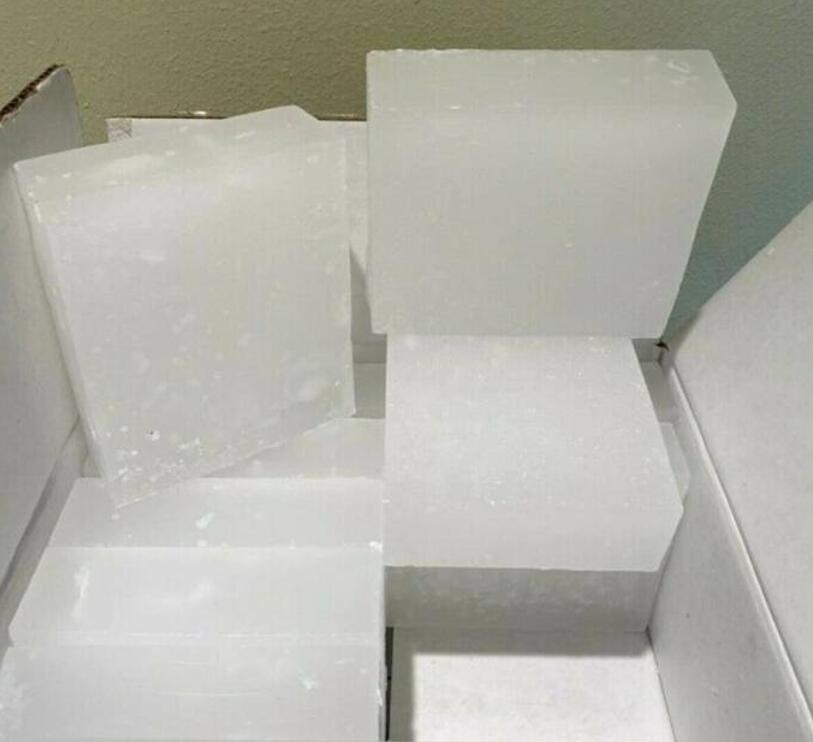
Undergoes secondary de-oiling + clay/hydrogenation deep purification, oil content lower than 0.8%, pure snow-white flaky crystal, odorless, narrow melting point range, excellent thermal stability and anti-oozing property. It passes strict safety certifications, applicable to industries with direct contact with food, human skin and medical products.
Key indicators: Ultra-low oil content, high whiteness, odor-free, food & pharmaceutical compliant, long-term anti-yellowing performance.
When To Choose Crude Paraffin Wax? Low-Cost Heavy Industrial Scenarios
Crude paraffin targets cost-sensitive bulk industrial production without strict purity limits, mainly applied in the below fields:
- Metal temporary anti-rust coating: Impregnate steel parts, iron castings and hardware to form short-term waterproof anti-corrosion layer for warehouse storage and transit protection.
- Fiberboard, canvas waterproof impregnation: Mix with auxiliary agents to improve water resistance of building boards, tarpaulins and construction waterproof materials.
- Match, torch fuel auxiliary raw material: Serve as combustion matrix to stabilize burning speed and enhance flame persistence.
- Low-grade industrial lubricant base: Used for heavy machinery chain lubrication, mold release agent for low-precision concrete components.
When To Choose Semi Refined Paraffin Wax? Mid-End Light Manufacturing & Candle Mass Production
Semi refined paraffin is the most versatile universal grade, covering mainstream civilian and light industrial mass production:
- Candle mass manufacturing: The primary raw material for household, religious and decorative candles, stable burning, less smoke, balanced production cost; high melting point grades fit high-temperature tropical export markets.
- Stationery & printing supplies: Raw material for wax crayons, carbon paper, iron pen wax paper, thermal transfer coating.
- Packaging & textile processing: Wax coating for food wrapping paper, carton waterproof layer, textile fabric soft finishing agent.
- General rubber & plastic auxiliaries: Internal lubricant and release agent for PVC, rubber sole, plastic profile production, improving product surface smoothness.
- Low-temperature precision casting, acoustic decorative board molding auxiliary.
When To Choose Fully Refined Paraffin Wax? High-End Food, Pharma, Cosmetic & Precision Industrial Fields
Only fully refined paraffin meets high-purity, low-impurity safety standards, irreplaceable for premium manufacturing:
- Food contact application: Fruit fresh-keeping coating, chocolate anti-stick layer, candy polishing wax, food packaging paper inner coating, complying with international food safety standards.
- Pharmaceutical excipients: Tablet coating matrix, ointment base, medical paraffin dressing raw material, low irritation and biocompatible.
- Cosmetic raw material: Lip balm, hand cream, skin care ointment carrier, pure white and odorless without irritating ingredients.
- Hot melt adhesive & electronic auxiliary: Narrow melting point ensures stable viscosity of hot melt glue; used for electronic component insulation sealing, high-frequency porcelain molding.
- Premium rubber, cable insulation: Anti-aging auxiliary for high-grade wire insulation layer, automotive rubber parts, reducing oil precipitation and prolonging service life.
Can Crude / Semi Refined Paraffin Replace Fully Refined Paraffin For High-End Production?
Clear conclusion: Not replaceable for food, medical and cosmetic production.
Crude and semi refined paraffin contain residual free oil and trace impurities. Under heating and long-term storage, oil seepage, yellowing and peculiar odor will occur, which fails safety testing and causes defective finished products.
For metal anti-rust, common candle and general rubber processing, semi refined or crude paraffin can control raw material expenditure while meeting basic production standards.
Quick Paraffin Wax Grade Selection Checklist For Industrial Buyers
Pick Crude Paraffin: Metal temporary rust prevention, fiberboard waterproofing, match production, heavy industrial low-grade lubrication
Pick Semi Refined Paraffin: Mass candle production, wax crayon, carbon paper, textile finishing, general rubber & plastic release agent
Pick Fully Refined Paraffin: Food coating, pharmaceutical tablet coating, cosmetic matrix, hot melt adhesive, electronic insulation, high-end precision casting
Common Procurement FAQs
Q1: How to select paraffin melting point for export candle production?
52#–56# semi refined paraffin fits cold temperate zones; 58#–62# high melting point grades suit high-temperature regions such as Middle East, Southeast Asia to avoid candle deformation during sea transportation.
Q2: Does fully refined paraffin have yellowing risk after long storage?
Qualified fully refined paraffin with low oil content maintains white crystal state for 2–3 years under dry and sealed storage, no obvious yellowing or oil leakage.
Q3: Is fully refined paraffin food safe?
Standard fully refined paraffin passes food contact material testing, allowed for indirect and direct food surface coating applications.
52#–56# semi refined paraffin fits cold temperate zones; 58#–62# high melting point grades suit high-temperature regions such as Middle East, Southeast Asia to avoid candle deformation during sea transportation.
Qualified fully refined paraffin with low oil content maintains white crystal state for 2–3 years under dry and sealed storage, no obvious yellowing or oil leakage.
Standard fully refined paraffin passes food contact material testing, allowed for indirect and direct food surface coating applications.