

Sinoright Blog
Saccharin Sodium: How to Choose?
Saccharin Sodium is a classic synthetic high-sweetness additive, widely used in food processing, daily chemicals, electroplating industry and feed production. In actual industrial procurement, grade (food/industrial) determines production safety compliance, while mesh size (particle fineness) directly determines dissolution speed, mixing uniformity and final product finish. Many production quality problems are caused by mismatched mesh size rather than unqualified purity. This article combines grade differences and mesh size characteristics to sort out full-scenario selection standards, helping factories accurately match raw materials and avoid production defects.
Core Difference: Food Grade vs Industrial Grade Saccharin Sodium
Food Grade Saccharin SodiumStrictly refined and impurity-removed, with ultra-low heavy metal residues and stable whiteness. It complies with international food safety standards, features pure sweetness without bitter aftertaste, and ensures safe application in food-contact, oral care and export-grade products. All mesh sizes of food-grade saccharin sodium meet food-level inspection requirements.
Industrial Grade Saccharin Sodium
Produced by conventional industrial processes without deep purification. Heavy metal and impurity indicators do not meet food safety standards. It maintains stable sweetening performance and cost advantages, only suitable for non-edible industrial auxiliary scenarios, and is strictly forbidden for food and feed production.
Actual Factory Mesh Specifications & Industrial Characteristics
Our factory supplies full-range conventional particle sizes: 5-8mesh, 8-12mesh, 10-20mesh, 20-40mesh, 40-80mesh. All specifications are uniform in particle size, free of powder and mixed particles, with stable dissolution and storage performance. Different mesh sizes correspond to completely different production scenarios.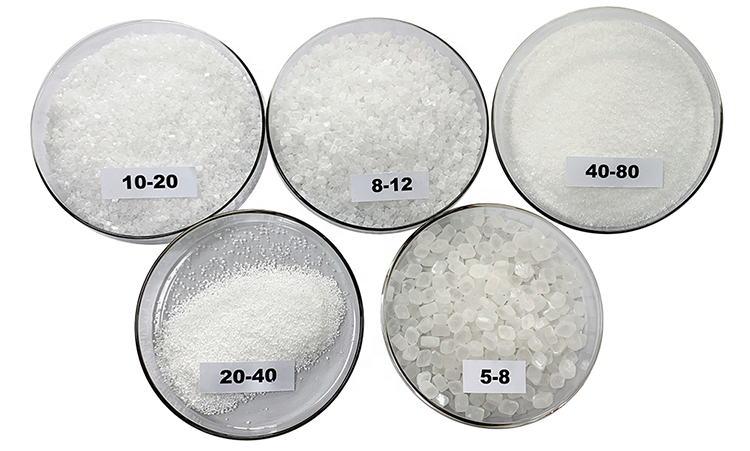
5-8 Mesh (Super Coarse Particle)
Large and uniform particles, extremely slow dissolution speed, anti-caking and long-term storage stability. Not suitable for rapid dissolving liquid formulas. Mainly used for products requiring long-term slow sugar release and no rapid sweetness penetration.
8-12 Mesh (Extra Coarse Particle)
Slightly finer than 5-8mesh, with steady dissolution rate, regular particle shape and low powder content. Ideal for medium slow-release production and materials that need layered sweetening during processing.
10-20 Mesh (Medium-Coarse Particle)
Balanced particle size, moderate dissolution speed, good fluidity and uniform mixing effect. It is a versatile specification, compatible with most solid food, feed and general industrial production with low application risks.
20-40 Mesh (Medium Particle)
Fine and uniform particles, fast dissolution than coarse specifications, no visible residue after dissolution. Suitable for conventional solid finished products and general electroplating production with moderate fineness requirements.
40-80 Mesh (Fine Particle)
The finest conventional mesh in our factory, with delicate particles, fast dissolution speed and high mixing uniformity. Perfect for fine solid products, low-viscosity liquid formulas and high-standard electroplating processes that require no particle residue.
Scenario Matching: Grade + Exact Mesh Size Double Selection Standard
Qualified mass production requires dual matching of grade and mesh size. Improper particle size will cause floating particles, precipitation, uneven sweetness, foggy coating and other batch quality problems.Food & Beverage Industry (Food Grade Only)
Liquid beverages & fine liquid products: 40-80meshFine particles dissolve quickly and completely without floating powder or precipitation, ensuring transparent liquid texture and uniform sweetness, suitable for bottled beverages, functional drinks and export liquid food.
Conventional solid food (candy, preserved fruit, baked food): 20-40mesh / 10-20mesh
Stable dissolution speed, uniform mixing with raw materials, stable sweetness release during high-temperature processing, avoiding local over-sweet or tasteless areas.
Slow-release solid food (chewing gum, long-boiled preserved fruit): 5-8mesh / 8-12mesh
Super coarse particles realize slow and sustained sweetness release, adapting to long-cycle processing and long-lasting taste requirements of special solid food.
Oral Care & Daily Chemicals (Food Grade Priority)
Toothpaste, mouthwash, fine flavor formulas: 40-80meshFine particles fuse fully with paste and liquid materials without granular sensation, ensuring pure taste and improving end-product usage experience.
Feed Additives (Food Grade)
Large-scale automatic feed production: 10-20mesh / 20-40meshGood particle fluidity, uniform dispersion in feed raw materials, effectively improving feed palatability and ensuring consistent batch taste.
Electroplating Industry (Industrial Grade Only)
Conventional nickel plating & alloy plating mass production: 20-40mesh / 10-20meshModerate dissolution speed, stable brightening performance, uniform plating crystallization, effectively improving coating flatness and gloss.
High-precision thin-layer electroplating: 40-80mesh
Fast and uniform dissolution eliminates local solution concentration difference, preventing pinholes and foggy coating defects and improving workpiece yield.
Low-demand industrial electroplating: 5-8mesh / 8-12mesh
Suitable for ordinary hardware electroplating with low fineness requirements to control raw material costs.
General Industrial Auxiliaries (Industrial Grade)
Industrial detergents, rubber auxiliaries, non-edible seasoningOptional full range of 5-80mesh specifications. Coarse particles (5-20mesh) are cost-effective for ordinary industrial formulas, while fine particles (40-80mesh) are used for high-precision industrial auxiliary production.
Can Industrial Grade or Mismatched Mesh Size Be Replaced?
Grade cannot be replaced; mesh size must be strictly matched.Industrial grade saccharin sodium contains excessive heavy metals and impurities, which is strictly prohibited for food, feed and oral products to avoid safety hazards and unqualified inspection. Mismatched mesh sizes will cause practical production failures: super coarse particles used in liquids lead to precipitation; ultra-fine particles used in slow-release products cause fast taste loss; improper particle size in electroplating results in inconsistent coating brightness.
Industrial Buyer Quick Selection Checklist
✅ Food Grade 5-8/8-12mesh: Chewing gum, slow-release preserved fruits, long-cycle processed solid food✅ Food Grade 10-20/20-40mesh: Candies, baked food, conventional feed additives, general daily chemicals
✅ Food Grade 40-80mesh: Beverages, toothpaste, mouthwash, high-end fine food liquid formulas
✅ Industrial Grade 5-8/8-12mesh: Low-standard hardware electroplating, ordinary industrial seasoning
✅ Industrial Grade 10-20/20-40mesh: Conventional alloy plating, industrial rubber auxiliaries, detergent additives
✅ Industrial Grade 40-80mesh: High-precision thin-layer electroplating, fine industrial auxiliary processing
Industrial Procurement FAQ
Q1: Why does beverage production have precipitation after adding saccharin sodium?It is mainly caused by overly coarse mesh size. 5-20mesh coarse particles dissolve slowly and cannot be completely dissolved in liquid, resulting in residual precipitation. Liquid products must choose 40-80mesh fine particles.
Q2: Which mesh size is the most cost-effective for mass feed production?
10-20mesh and 20-40mesh food grade are the most suitable, with balanced fluidity and mixing effect, stable quality and low comprehensive cost.
Q3: How does particle mesh affect electroplating quality?
Coarse particles (5-12mesh) dissolve slowly, leading to uneven solution concentration and foggy coating; medium and fine particles (20-80mesh) dissolve stably, ensuring uniform brightness and flatness of electroplated workpieces.
Q4: Can coarse mesh saccharin sodium replace fine mesh for general production?
Not recommended. Coarse particles cannot achieve fine processing effects. Liquid and high-precision production must use matched fine mesh to avoid quality risks.